Welcome to the PurPest Project website

“You can’t defend. You can’t prevent. The only thing you can do is detect and respond”

(Bruce Schneier)

Welcome to the PurPest Project website

“You can’t defend. You can’t prevent. The only thing you can do is detect and respond”

(Bruce Schneier)

Welcome to the PurPest Project website

“You can’t defend. You can’t prevent. The only thing you can do is detect and respond”

(Bruce Schneier)

Welcome to the PurPest Project website

“You can’t defend. You can’t prevent. The only thing you can do is detect and respond”

(Bruce Schneier)

Welcome to the PurPest Project website

“You can’t defend. You can’t prevent. The only thing you can do is detect and respond”

(Bruce Schneier)

PurPest at 9th International Conference on Materials Science & Nanotechnology


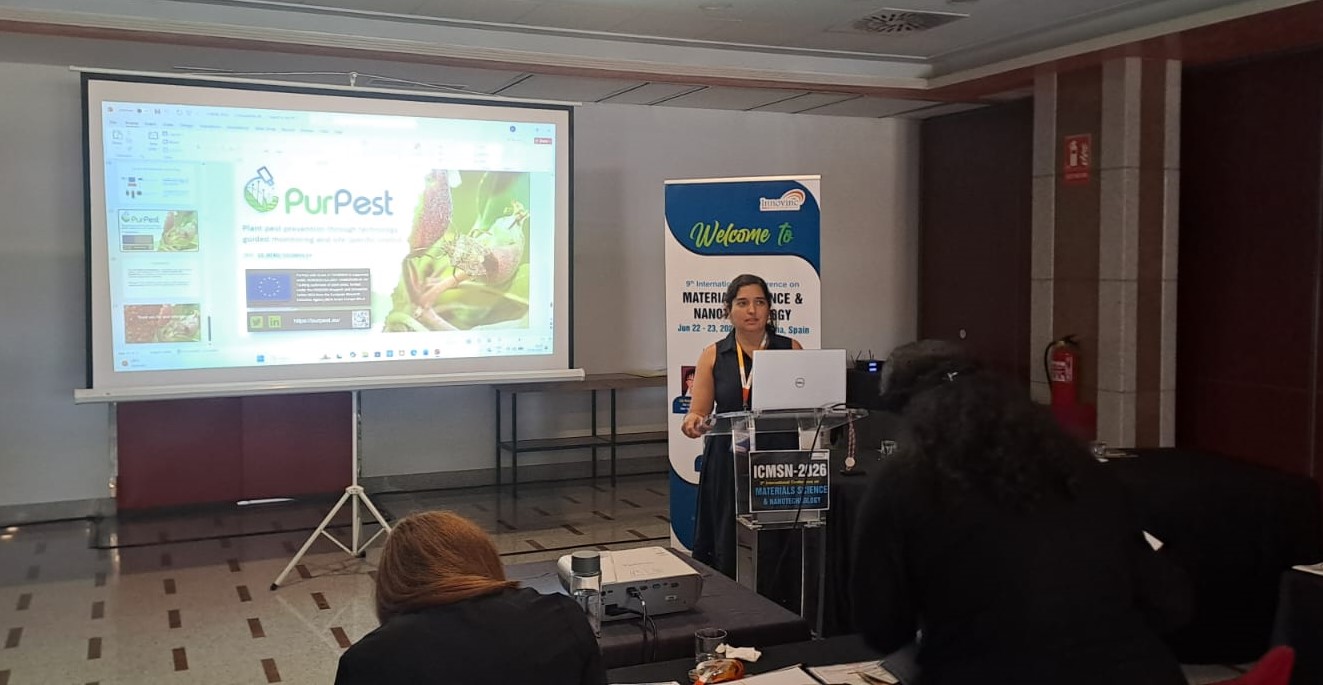
The PurPest project was represented at the 9th International Conference on Materials Science & Nanotechnology (ICMSN 2026), held in Barcelona, Spain, on 22–23 June 2026, through a presentation delivered by former project researcher Maria João Camacho.

Entitled "Smart sensor technologies for sustainable agriculture: New frontiers in nematode detection", the presentation showcased innovative approaches being developed within PurPest to enable rapid, non-invasive, and field-deployable detection of plant pests and diseases.

The work highlighted PurPest's portable sensing platform, designed to detect volatile organic compounds (VOCs) emitted by plants under stress and by pests such as the pinewood nematode (Bursaphelenchus xylophilus). Combining technologies including pre-concentrators, 3D-printed micro gas chromatography (μ-GC), advanced materials, and surface-enhanced Raman scattering (SERS) sensors, the system aims to support earlier pest detection and more precise crop protection decisions.

By bringing together expertise from materials science, nanotechnology, molecular biology, and plant health, these research initiatives illustrate the growing potential of integrated sensor platforms to transform pest surveillance and support more sustainable farming practices.

The conference presentation marked Maria João's final dissemination activity connected to PurPest following the completion of her involvement in the project. Throughout her time with PurPest, she contributed to advancing innovative detection technologies for plant-parasitic nematodes and helped communicate the project's scientific achievements to international audiences.

We thank Maria João for her contributions to PurPest and wish her every success in the next stage of her scientific career.