Welcome to the PurPest Project website

“You can’t defend. You can’t prevent. The only thing you can do is detect and respond”

(Bruce Schneier)

Welcome to the PurPest Project website

“You can’t defend. You can’t prevent. The only thing you can do is detect and respond”

(Bruce Schneier)

Welcome to the PurPest Project website

“You can’t defend. You can’t prevent. The only thing you can do is detect and respond”

(Bruce Schneier)

Welcome to the PurPest Project website

“You can’t defend. You can’t prevent. The only thing you can do is detect and respond”

(Bruce Schneier)

Welcome to the PurPest Project website

“You can’t defend. You can’t prevent. The only thing you can do is detect and respond”

(Bruce Schneier)

PurPest Stakeholder Webinar: VOC sensors for early pest and pathogen detection

Stakeholder webinar final 

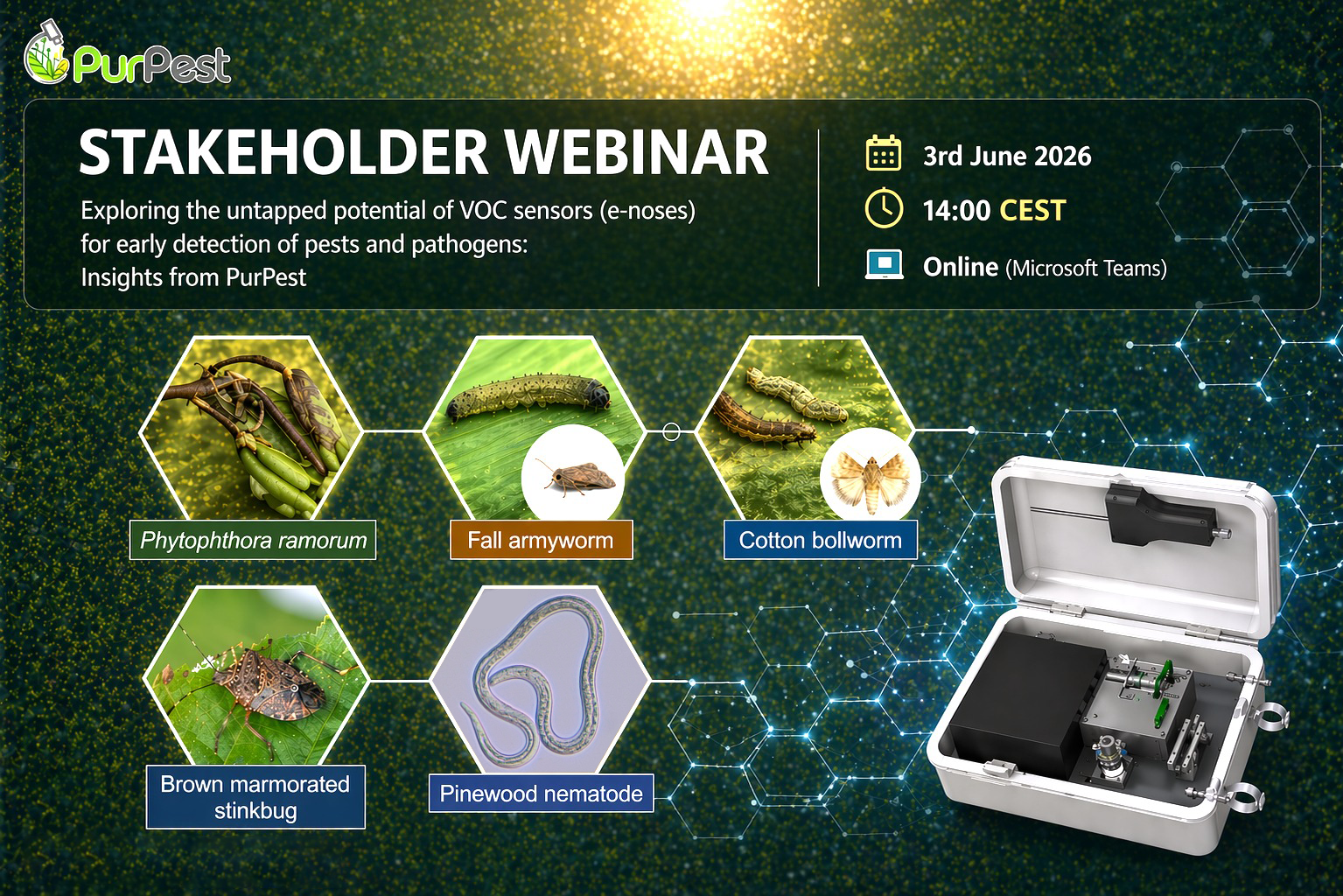
European agriculture, horticulture, and forestry face mounting pressure from invasive pests and pathogens, including Phytophthora ramorum, the pinewood nematode (Bursaphelenchus xylophilus), and insect threats such as the fall armyworm (Spodoptera frugiperda), cotton bollworm (Helicoverpa armigera), and brown marmorated stink bug (Halyomorpha halys). These organisms threaten crop yields, forest health, and ecosystem stability across the continent.

Global trade networks facilitate the movement of plants and plant products and increase the risk of unintentional pest and pathogen introductions across Europe. Phytosanitary inspections are often conducted under time and resource constraints and may fail to detect infestations, particularly when infections remain latent or asymptomatic. Plant health practitioners across Europe have therefore emphasized the need for faster and more accessible diagnostic tools to support early detection and on-site decision-making.

The PurPest project addresses this challenge by developing Volatile Organic Compound (VOC)-based “e-nose” technologies for the early detection of pests and pathogens. These technologies could support rapid, non-destructive screening in, e.g., nurseries and border control points across Europe.

The webinar will provide an overview of the PurPest target pests and pathogens, and the work conducted within the project, including VOC sensor development and socioeconomic implications.
REGISTRATION
Deadline for registration June 2, 2026
(All fields are required)
All information you submit will be kept within the scope of the PurPest project and will NOT be processed by third parties.


PROGRAMME

Time Zone: Central European Summer Time (CEST)

OPENING
14:00 Introduction to the HEU PurPest project, by Andrea Ficke (NIBIO, Norway)
PURPEST TARGET PESTS: RELEVANCE AND CURRENT STATUS
14:05 Fall armyworm (Spodoptera frugiperda), by Ted Turlings (UNINE, Switzerland)
14:10 Phytophthora ramorum, by Thomas Jung (MENDELU, Czechia)
14:15  Pinewood nematode (Bursaphelenchus xylophilus), by Jorge Faria (INIAV, Portugal)
14:20 Cotton bollworm (Helicoverpa armigera), by Jörg Römeis (WBF, Switzerland)
14:25 Brown marmorated stink bug (Halyomorpha halys), by Jana Collatz (WBF, Switzerland)
VOC SENSOR DEVICE
14:30 Concept, uses, performance/development state, by Damien Bazin (AIRMOTEC, France)
SOCIO-ECONOMIC IMPLICATIONS
14:45 Potential direct damage costs of PurPest target pests and adoption potential of the VOC sensors in European nurseries, by Stelios Kartakis (WUR, Netherlands)
Q&A SESSION
15:00 Discussion with the audience
15:30 Conclusion / End


PurPest Webinar Code of Conduct


PurPest webinars are intended to provide a professional, respectful, inclusive, and harassment-free environment for all participants. By joining this event, participants agree to:

  • engage respectfully and professionally with others;
  • refrain from exploiting participation in the event for communication of political statements, views, or opinions, or using any discriminatory, offensive, or disruptive behaviour or language
  • contribute to a constructive atmosphere for discussion and exchange.

Any inappropriate conduct may be reported to the organizers. The PurPest project reserves the right to remove any participant whose behavior is considered inappropriate. Decisions of the organizers in such cases are final.